FAQ: All About Ants
If you have a question that is not answered in this FAQ, feel free to get in touch with Empire of Ants!
1. What are ants? A: Ants are social insects belonging to the kingdom Animalia, phylum Arthropoda, class Insecta, order Hymenoptera, family Formicidae. They are the most species-rich insects on Earth, with an estimated 10,000-plus species worldwide and an estimated 300 to 400 in Taiwan. Ants are highly habitat-specific insects and hold an extremely important ecological position, helping to balance species populations and acting as decomposers.
2. What is a social insect?
A: A social insect is one that exhibits social interaction, with the characteristics of cooperative brood care, division into castes with care provided between them, and overlapping generations. They divide labour by caste and by age, with the non-reproductive caste caring for the reproductive caste, and at least two generations coexist in the same colony, giving rise to complex social structures and behaviours.
3. How big is the largest ant in the world?
A: The largest ant in the world is the giant forest ant, Camponotus gigas, found in Southeast Asia and Borneo. The queen can reach 3 to 4 cm in length!
4. Do ants have eyes?
A: Most ants do have eyes, though a few species, having lived in darkness for so long, have no eyes at all. Even among the ants that have eyes, most have poor eyesight, because they live in dark places and so the function of the eyes has become less important. The eyes are divided into “ocelli” (simple eyes) and “compound eyes.” There are three ocelli, used for sensing light, while the compound eyes can form images and serve as a true sense organ. Only large ants or queens have ocelli, however.
5. How do ants communicate?
A: Ants communicate using pheromones. They have various glands that release pheromones for scent marking, and they receive the meaning of those messages with their antennae. Some ants also use sound to pass on information: some have body structures that can produce sound, while others tap their abdomen on the ground to make noise or vibrate their bodies to warn their nestmates to be on alert.
6. What are the castes of ants?
A: The castes of ants are:
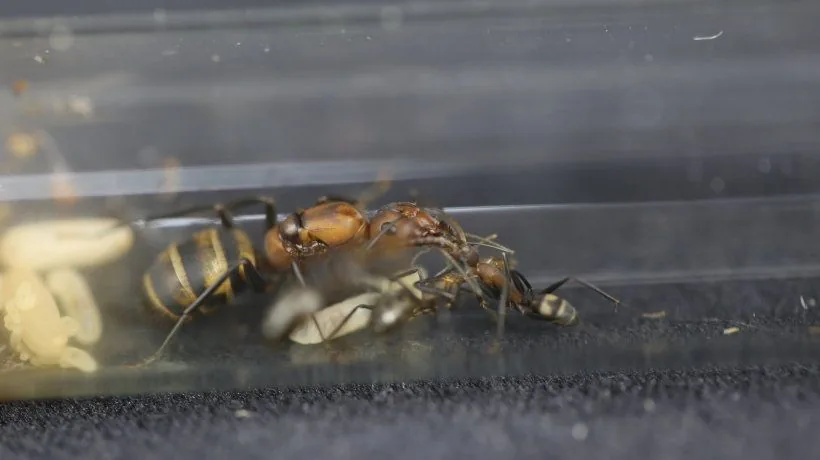
Queen: A mated female ant. She is responsible only for laying eggs in the colony. She is the largest individual, with a thick thorax built for flight and a large abdomen due to ovary development and egg swelling.
Alate female: A queen that has not yet mated. She waits in the colony for the right moment to take part in the nuptial flight and mate, and serves no function within the colony. She is among the largest individuals and has wings for the purpose of the nuptial flight and mating.
Male: The only male individual among ants. He waits in the colony for the right moment to take part in the nuptial flight and mate, and serves no function within the colony. He has wings, a small head, a thick thorax built for flight, and a slender abdomen for mating.
Soldier: Serves as the attack or defence caste in the colony. The head is larger due to well-developed muscles, giving a stronger bite. Some ants have no soldier caste; where present, soldiers make up a certain proportion of the colony.
Worker: The smallest individuals in the colony, with a wide range of duties assigned by age: nest building, foraging, scouting, relocating, caring for eggs and larvae, tending the queen and the reproductive castes, and so on. In every species of ant, workers are the most numerous.
7. How do ants mate?
A: Ant mating is seasonal. Under certain weather conditions such as humidity, temperature and wind, on a few specific days the reproductive castes (males and alate females) fly out during that window to mate. This is called the “nuptial flight.” In Taiwan, nuptial flights generally happen all year round, varying only in number and species.
8. Once an ant has mated, can she keep laying eggs forever?
A: Several males inject sperm into the female’s abdomen. The female has a special structure in her body that stores the sperm and lets her decide whether or not each egg is fertilised. The males die after mating, and the sperm they provide is enough for the female to keep laying eggs until the natural end of her life.
9. How do ants determine sex and caste?
A: Like bees, ants live in a matriarchal society. Only fertilised eggs produce female ants, such as workers, soldiers and alate females. As for caste, this is still being researched. In some ants, genetics determine whether a given fertilised egg will develop into a worker, soldier or alate female; in others, it may be the way the larva is raised that changes the caste it eventually becomes.
10. How long do ants live?
A: An ant’s lifespan depends on how long it takes to develop from egg to adult. Smaller individuals take less time from egg to adult and have shorter lives; conversely, larger individuals take longer from egg to adult and live longer. In general, a small worker takes anywhere from a few days to under a month to go from egg to adult and can live for tens of days to several months. A large worker takes around 2 to 6 months from egg to adult and can live 1 to 6 years. Queens live even longer, anywhere from 1 to 3 years up to 10 to 20 years!
11. What do ants eat?
A: Like other animals, ants differ in diet. They have particular feeding habits according to where they are found, and have evolved special structures to match. Most ants, however, feed on other insects, some on dead ones and some on live ones. Some ants feed on plant secretions or the secretions of symbiotic insects. A few specialise in seeds or in fungus gardens they cultivate themselves.
You are welcome to share and repost this article, but please credit the source.