A Brief Introduction to Ants and Important Reminders
Dieser Artikel ist derzeit nur auf Chinesisch und Englisch verfügbar. Nachfolgend die englische Fassung.
Ants are social insects of the phylum Arthropoda, class Insecta, order Hymenoptera, family Formicidae. There are tens of thousands of ant species in the world. In the time it takes you to read this sentence, nearly 250,000,000 ants are born worldwide. Amazing, isn’t it!? Around 10,000-plus species have been formally named worldwide so far, with about 223 named in Taiwan. Counting undescribed species, the global total is estimated at more than 20,000!
“Every species of ant has its own temperament and character. Some are fierce; some are timid; some fight alone; some cooperate seamlessly; some are bizarre; some are stunning.
Ants are highly intelligent creatures. Every one of their behaviours has meaning and value, which makes them worth observing.
Observing ants is a form of life education. It lets you appreciate the mysteries and wonders of nature, and their remarkable intelligence will make you admire and cherish them all the more.
Their loyalty,
their unity,
will leave you in awe.”
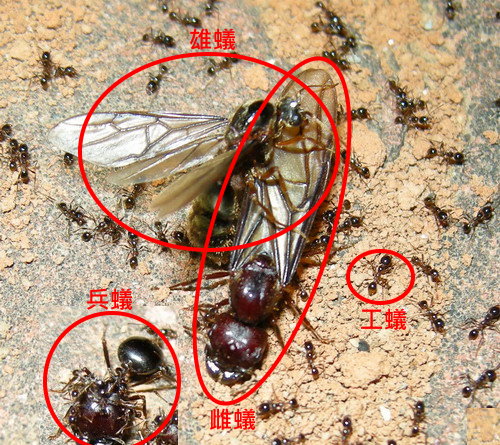
The ant world is made up of several types of individual: males (the second-largest individuals in the colony after the alate females, with a small head and a mosquito-like appearance), alate females (called queens once mated), soldiers (many species have no such individuals) and workers. Unlike ordinary insects, in the ant world every individual except the male is female. Unfertilised eggs hatch only into males (parthenogenesis being the exception). After the nuptial flight and mating, the female stores the male’s sperm inside her body, and the queen’s sperm-storage organ can control the release of sperm, so she can decide whether to produce male or female offspring. ※ Note: The nuptial flight is how ants mate. It refers to the process, during a particular season, in which males and alate females fly up into the sky to find a partner, mate, and then land.
*Workers: Responsible for most of the work in the colony, such as guarding the brood, feeding the larvae and the other castes, nest building, foraging, guarding, defence and relocating the nest*
*Soldiers: Responsible for guarding and defence in the colony*
*Males: Have no job in the colony… they wait for the nuptial flight season, when they are responsible for continuing the line, and die after mating*
*Alate females: Have no job in the colony… they wait for the nuptial flight season, when they are responsible for continuing the line. After mating they become queens, and once a queen, all she has to do is lay eggs*
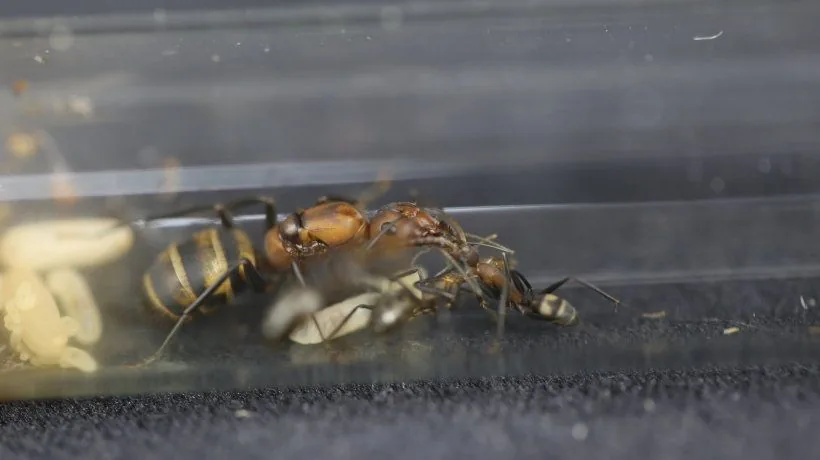
※ Using Pheidologeton diversus as an example; image source bastand670
After the nuptial flight, in some polygynous (multi-queen) species the queens return to their birthplace and lay eggs together, or they may set out on their own; in monogynous (single-queen) species the queen finds her own sheltered spot and prepares to start laying.
Because of this trait, ants cannot easily be bred in captivity!
Ant colonies pass through several stages: 1. New queen: just after the nuptial flight, before any workers have emerged
(As distinct from “single-queen”: “single-queen” usually means there is only one queen in the colony)
2. Founding colony: a queen that survived the nuptial flight has successfully raised her first to third batches of workers 3. Small colony: generally means the numbers after the third batch of workers (varies with the species’ output) 4. Mature colony: generally means a colony that has reached its mature size, with worker numbers growing steadily ※ Note: Every species is different. Some small ants can reach colonies of tens of thousands, which calls for a different way of classifying colonies; for some ants, a colony of 50 is already the limit.
Apart from colony stages, there are also single-queen, two-queen or multi-queen colonies! Each species has its own characteristics; not every ant is strictly monogynous or polygynous, and there is such a thing as pseudo-polygyny too!
The more workers a colony has, the more stable it is; the fewer, the more precarious. Queens and soldiers rely on workers to feed them, so the fewer workers there are, the greater the chance that the queen and soldiers go hungry! That is why the bigger the colony, the more stable it is!
Also, ants differ in diet, just as a tiger fed vegetables would rather starve than eat them! There are five types: 1. Carnivorous: mainly feed on small insects e.g. mealworms, crickets, red runner roaches, termites, etc. 2. Herbivorous: mainly feed on fruit and tree sap, and occasionally catch small insects e.g. honey water, beetle jelly, etc. 3. Omnivorous: eat both
-
Seed-eating: mainly feed on seeds e.g. plant seeds
-
Fungus-growing: mainly feed on fungus (which the ants cultivate themselves)
※ (For special points to note when keeping carnivorous ants, see: Ant Larvae vs. Cocoons: Telling the Stages Apart)
※ Note: Carnivorous ants will not eat fruit or beetle jelly (they will drink honey or sugar water), while herbivorous and omnivorous ants occasionally need a top-up of animal protein, so feed them small insects now and then too. Be careful not to feed household pests such as mosquitoes or cockroaches, because some carry residual pesticide toxins, and accidentally feeding those can wipe out the whole colony!
In addition, different ants have different nesting habits: arboreal, ground-nesting, nesting inside other structures, leaf-weaving and so on. So not every species is suited to a plaster nest! Pay special attention to this!
Next is the ants’ placement: do not put them where there are large temperature swings, where it is too hot or too cold, in direct sunlight, or anywhere with chemical odours in the air (such as mosquito coils). Ants generally dislike light and vibration, so keep them in a dim place or cover them, and try to avoid frequent large changes in light as well as vibration. The ideal temperature varies by species.
In short, ant keeping comes down to clean water, non-toxic food, a well-ventilated environment, the right temperature and humidity, and a suitable home, and your ants will thrive and multiply in good health!