Can You Keep Ants in Blue Gel?
Este artículo solo está disponible en chino e inglés por el momento. A continuación se muestra la versión en inglés.
Over the years, plenty of people have asked me whether a certain blue gel product is suitable as a nest for keeping ants, so I have written this article to explain the answer properly!
First, let’s be clear about what we mean by an “ant nest” (formicarium). Put simply, it is the container you keep ants in.
So the single most important feature of a nest is that it must “keep the ants alive.” That is the first and most essential requirement.
There are a few more things to consider. Ants live in every corner of the world, and each of those corners has its own environmental conditions.
Those conditions are exactly what we have to provide when keeping ants in captivity.
That is why “not every nest is suitable for every ant species.” That covers the basic definition of a “nest.”
Now back to the blue gel. Every product has its own purpose and characteristics, and the real purpose of this one
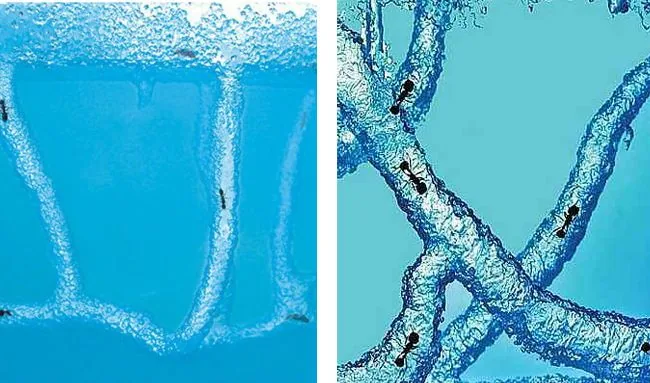
is “observing ants digging.” Because it is highly transparent and the gel is quite soft, it works well for watching that particular behavior.
But that kind of environment “is not somewhere ants can live long-term,”
because the product was designed for the purpose just mentioned: “observing ants digging.”
In fact, there are two kinds of digging behavior:
- Nest building: Genuine nest building only happens when “the species is suited to it and the environment is suitable.”
Note: Digging of this kind produces chambers and tunnels, and the ants live inside the chambers.
- Moving: Once the ants have explored all the open space, they turn to the more laborious option, which is digging.
In the gel product, the space on top is small. After exploring it, the ants decide that digging downward might lead to another way out,
because they know that staying put will kill them. So they dig downward in an attempt to leave.
Note: Digging of this kind produces random, curving lines, just tunnels with no chambers, and the ants do not gather inside them.
These two behaviors look different and produce different results. In short, the gel product works by “trapping the ants so they cannot leave and dig downward,” because if it is not nest building, ants will only dig when they are confined.
One more key point: “not all ants dig to move or build nests.” It is generally only ground-nesting species that do, so even if you collect ants outside and put them in, they will not necessarily dig at all!
To sum up, this kind of product is unsuitable as a nest because:
-
The environment is not one ants can live in long-term.
-
The gel is not food and has no nutritional value, and if it did, it would quickly grow mold or rot!
-
It forces the confined ants into abnormal behavior, and that excessive exertion makes them die early!
-
It conveys no correct information or knowledge, only entertainment, and it does not even tell the consumer which species of ant is suited to it.
That is our comparison between this gel product and the products we actually use as “nests.”
If you have any further questions, feel free to contact us at any time.